You’re eating well, drinking water, getting decent sleep — and you’re still dragging by mid-afternoon. What gives?
Fatigue can have many causes, from stress and poor sleep to medications or underlying health conditions. But nutrition can play a role too, especially when a true nutrient deficiency is present.
Several nutrients help your body convert food into usable energy, make healthy blood cells, and deliver oxygen throughout the body. When levels become too low, fatigue may be one of the symptoms.
B Vitamins: Helping Your Body Use the Fuel You Eat
B vitamins don’t provide calories or energy themselves, but several of them are essential for the chemical reactions that help your body metabolize carbohydrates, fats, and proteins.
Vitamin B6, for example, participates in more than 100 enzyme reactions involved in metabolism. Folate is important for DNA synthesis and cell division, while vitamin B12 supports healthy blood and nerve cells and is needed for normal red blood cell production.
When vitamin B12 deficiency becomes significant, fatigue and weakness can occur, sometimes because of megaloblastic anemia. B12 deficiency can also cause neurologic symptoms even when anemia is not present.
B vitamins are found across a wide range of foods, including poultry, fish, eggs, legumes, leafy greens, potatoes, fruit, and fortified grains. Vitamin B12 occurs naturally primarily in animal foods, so people following vegan diets generally need reliable fortified foods or a B12 supplement.
Try this: When planning your grocery list, include a variety of B-vitamin-rich foods such as eggs, fish, beans, leafy greens, or fortified whole grains.
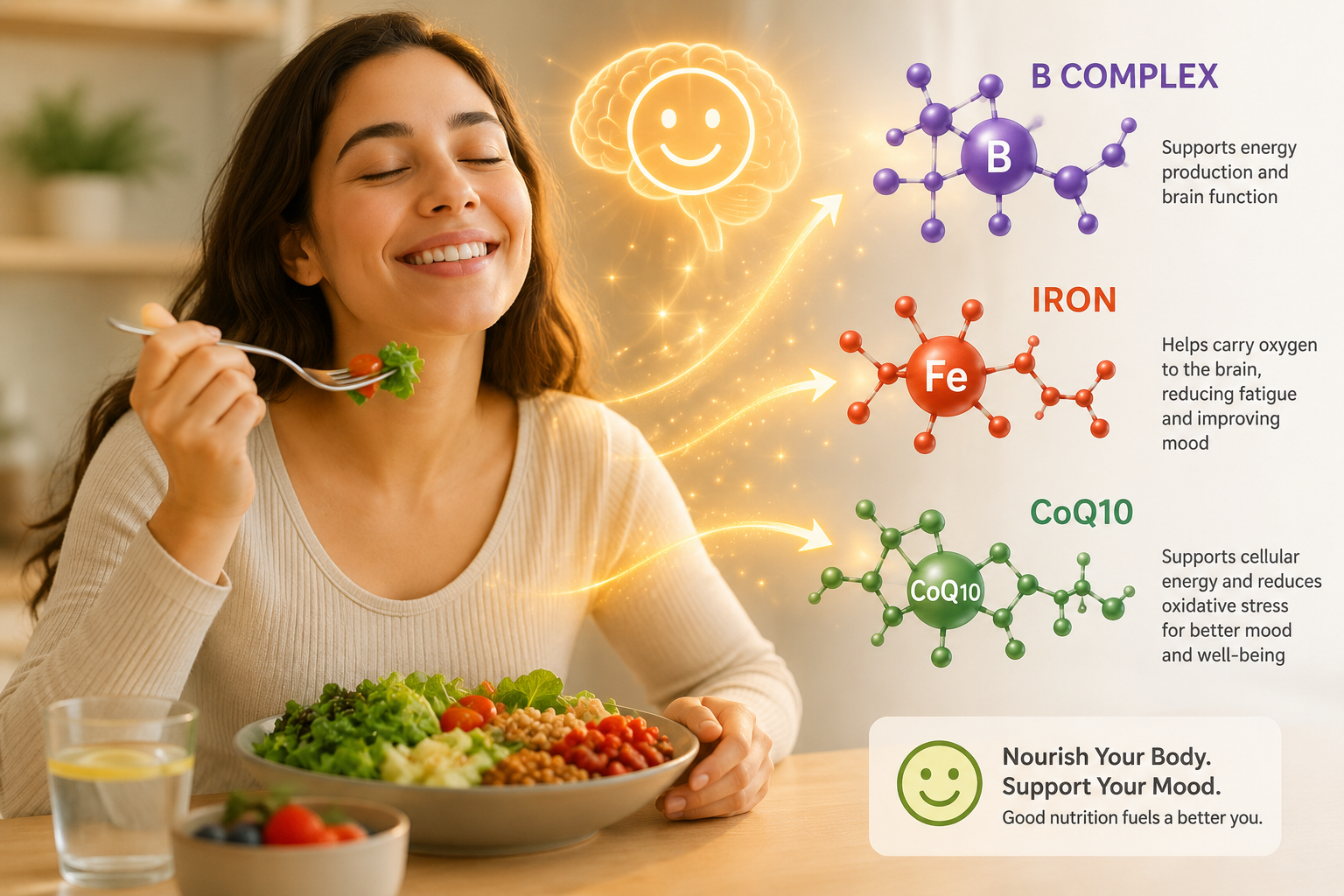
Iron: Helping Carry Oxygen
Iron is an essential part of hemoglobin, the protein in red blood cells that transports oxygen from the lungs to tissues throughout the body.
When iron stores become severely depleted and iron-deficiency anemia develops, the blood carries less oxygen. Common symptoms include fatigue, weakness, low energy, and difficulty concentrating.
Iron-rich foods include meat, seafood, beans, lentils, tofu, fortified grains, and some leafy greens.
Vitamin C can help increase the absorption of non-heme iron, the form found in plant foods. Pairing foods such as beans or lentils with bell peppers, tomatoes, berries, or citrus can therefore be a useful strategy. That said, more vitamin C is not necessarily better, and routine high-dose vitamin C supplementation is not needed for most people taking iron.
Try this: Pair a plant-based iron source with a vitamin C-rich food — for example, lentils with tomatoes, beans with bell peppers, or iron-fortified cereal with berries.
CoQ10: Important for Mitochondrial Energy Production
Coenzyme Q10, or CoQ10, is a compound your body produces naturally. It plays an important role in the mitochondrial electron transport chain, one of the systems cells use to produce ATP, their main form of usable energy.
CoQ10 is also found in small amounts in foods such as meat, fish, nuts, and some vegetables.
However, this is where it’s important not to overstate the evidence. Low dietary CoQ10 has not been established as a common cause of everyday fatigue, and there is not strong evidence that eating more CoQ10-rich foods will noticeably increase energy.
Some randomized trials have studied CoQ10 supplements for fatigue. A 2022 meta-analysis found a modest improvement in fatigue scores across 13 randomized trials, but more recent reviews have emphasized that results vary by population and that the overall certainty of evidence remains limited.
So rather than treating CoQ10 as an everyday “energy booster,” it is more accurate to think of it as an important part of normal cellular energy metabolism that continues to be studied for specific clinical uses.

The Bigger Picture
Energy isn't just about calories in. It's about whether your body has the tools to use those calories efficiently. B vitamins spark the process, iron delivers oxygen to power it, and CoQ10 keeps your cellular engines charged. When all three are working, energy stops being something you chase and starts being something you just have.
Sources
- NIH Office of Dietary Supplements. Vitamin B12: Fact Sheet for Health Professionals
- NIH Office of Dietary Supplements. Vitamin B6: Fact Sheet for Health Professionals
- NIH Office of Dietary Supplements. Folate: Fact Sheet for Health Professionals
- NIH Office of Dietary Supplements. Iron: Fact Sheet for Health Professionals
- Systematic review and meta-analysis of vitamin C added to oral iron therapy in iron-deficiency anemia. PubMed
- Tsai et al. Systematic review and meta-analysis of randomized controlled trials evaluating CoQ10 and fatigue. PubMed
- Recent systematic review and meta-analysis of CoQ10 supplementation and fatigue/exercise outcomes. PubMed