You’ve probably had a “gut feeling” before — that sense in your stomach that something isn’t quite right.
There really is an ongoing conversation between your digestive system and your brain. Scientists call this the gut-brain axis: a two-way communication network involving the nervous system, immune system, hormones, and compounds produced by gut microbes.[1]
The vagus nerve is one important pathway in that communication, carrying signals between the digestive tract and the brain. But it isn’t the only one. Gut microbes can also influence immune signaling, stress-response pathways, and the production of metabolites that may affect how the brain functions.[1,2]
You may have heard the gut called the “second brain.” That nickname actually refers to the enteric nervous system — the extensive network of nerve cells embedded throughout the gastrointestinal tract.
The gut is also an important immune organ and is home to a large proportion of the body’s immune cells.[3] And although most of the body’s serotonin is produced in the gastrointestinal tract, there is an important caveat: gut serotonin does not simply travel into the brain and become brain serotonin. Peripheral and brain serotonin largely function in separate systems.[4]
So the gut-brain connection is real — but it is more complex than “happy gut = happy brain.”
Two Partners: Helpful Microbes and the Foods That Feed Them
Your digestive tract contains trillions of microorganisms collectively known as the gut microbiome. Diet is one of several factors that can influence which microbes thrive and what compounds they produce.
Two terms you’ll hear often are probiotics and prebiotics.
🧫 Foods With Live Microbes
Foods such as yogurt with live cultures, kefir, kimchi, and some types of sauerkraut can contain live microorganisms.
Some specific microorganisms have been studied as probiotics, meaning they have demonstrated a health benefit when consumed in adequate amounts. However, not every fermented food or live bacterial strain automatically qualifies as a probiotic.
Researchers are also studying certain probiotic strains for possible effects on stress, anxiety, and depression. You may see these referred to as “psychobiotics.”
The research is promising, but still developing. Recent systematic reviews suggest that some probiotic interventions may modestly improve depressive or anxiety symptoms in certain populations, but results vary considerably depending on the strain, dose, population, and study design.[5,6]
For now, probiotic foods are best viewed as one part of an overall nutritious diet — not as a treatment for depression or anxiety.

🌾 Prebiotic Fibers
Prebiotics are specific substances that are used by microorganisms in the body and provide a health benefit. Many are types of fermentable fiber.
Foods that provide prebiotic or fermentable fibers include:
- Garlic and onions
- Beans and lentils
- Oats and barley
- Slightly green bananas
- Asparagus
- Whole grains
- Cooked-and-cooled potatoes and other starches
Examples include fructans such as inulin, resistant starch, and beta-glucans.
Human trials show that increasing certain dietary fibers can increase bacteria such as Bifidobacterium and Lactobacillus and may increase production of compounds such as butyrate.[7]
There is also early research examining whether prebiotics influence stress responses. One small randomized controlled trial found that a specific galacto-oligosaccharide supplement reduced the cortisol awakening response and changed emotional processing in healthy adults — but another controlled trial did not find improvements in cortisol, stress, or mental-health symptoms.[8,9]
So this is an interesting area of research, but it is too early to say that eating more prebiotics will reliably lower cortisol or improve mood.

The Microbiome’s Important Output: Short-Chain Fatty Acids
One reason fiber matters is what happens after you eat it.
Certain gut bacteria ferment fibers that reach the colon and produce compounds called short-chain fatty acids, or SCFAs. The main SCFAs include acetate, propionate, and butyrate.
These compounds have several important roles in the gut. Butyrate, for example, serves as an important fuel source for cells lining the colon and is involved in maintaining the intestinal barrier and regulating immune and inflammatory signaling.[10]
Scientists are also studying how SCFAs may participate in gut-brain communication through immune, hormonal, metabolic, and neural pathways.[10]
This research is exciting, but there is an important distinction between what we know from laboratory and animal studies and what has been proven in humans.
For example, experimental research suggests that butyrate may influence the blood-brain barrier, neuroinflammation, and neuroplasticity. However, direct evidence that increasing butyrate through diet improves mood, memory, or brain-cell growth in humans is still limited.[10]
The practical recommendation is much simpler — and much better established:
Eat a variety of fiber-rich plant foods.
Whole grains, beans and lentils, vegetables, fruits, nuts, and seeds provide different types of fibers and other compounds that interact with the gut microbiome. Controlled dietary studies show that higher-fiber dietary patterns can alter microbial composition and increase certain SCFA-producing bacteria.[7,11]
You do not need to chase one “perfect” prebiotic food.
What Can Affect Your Gut Microbiome?
Your microbiome is influenced by much more than one food or ingredient.
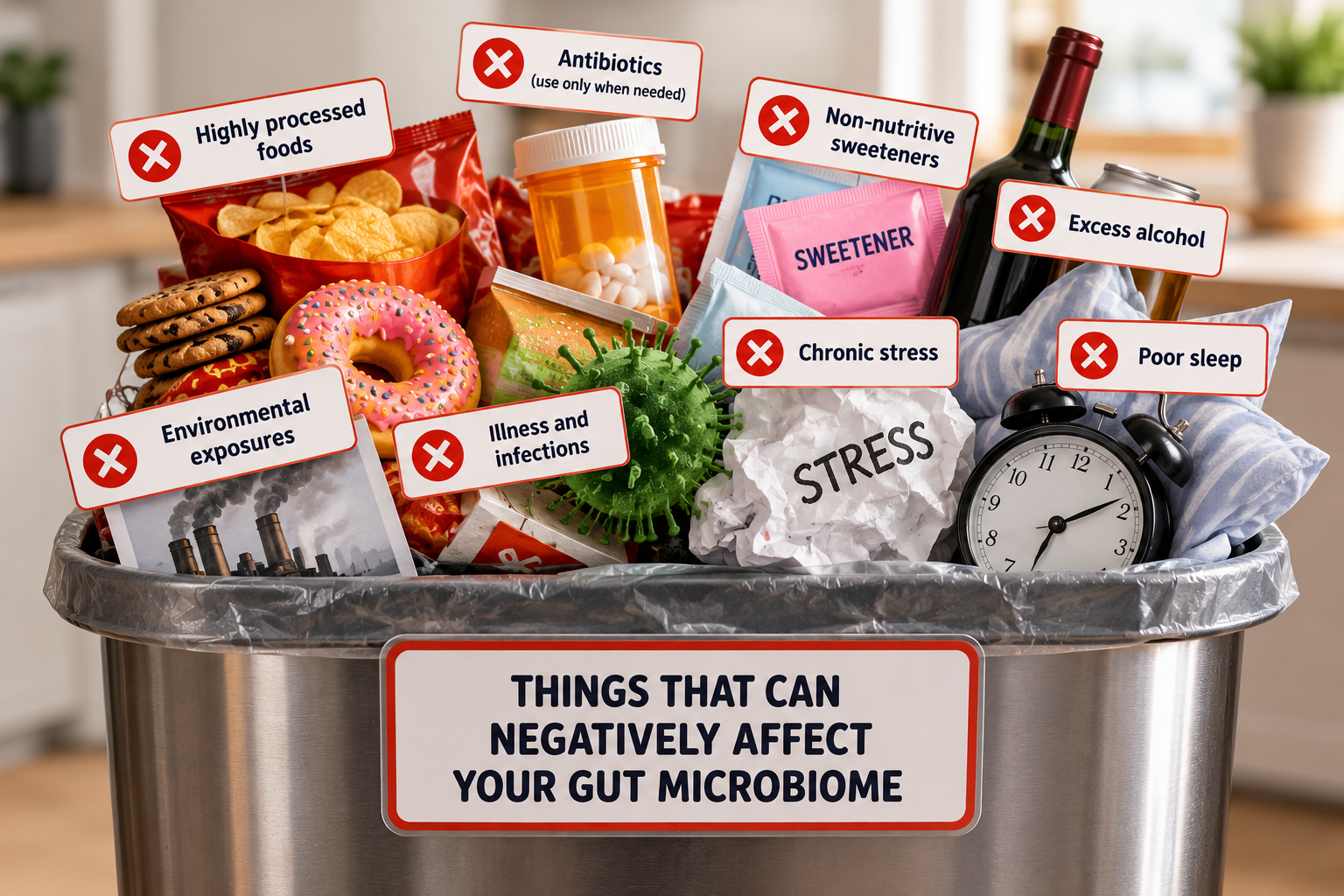
Diet, medications, illness, age, sleep, stress, environment, and many other factors can all influence microbial communities.
Antibiotics can significantly disrupt the gut microbiome, which is one reason they should be used appropriately rather than unnecessarily. At the same time, antibiotics are important and sometimes lifesaving medications when medically indicated.
Highly processed dietary patterns are also being studied for their potential effects on the microbiome. Emerging human research suggests that diets high in ultra-processed foods may be associated with differences in microbial composition, but researchers are still working out which aspects of these diets — such as lower fiber intake, food additives, overall diet quality, or other factors — are responsible.[11]
The story with non-nutritive sweeteners is even less clear. Some human studies have reported microbiome changes with certain sweeteners, while others have found little or no effect. Current evidence does not justify saying that artificial sweeteners as a group “destroy” healthy gut bacteria.[12]
Instead of fearing individual ingredients, focus on the overall dietary pattern: plenty of fiber-rich plant foods, adequate nutrition, and a variety of minimally processed foods.
Small Habits for a Healthier Gut
- Breakfast habit-stack: Add a fiber-rich or fermented food to breakfast. Try yogurt with oats and berries, whole-grain toast with fruit, or oatmeal topped with nuts and seeds.
- Cooking habit-stack: Add vegetables, beans, garlic, onions, herbs, or whole grains to meals when they fit naturally.
- Plating habit-stack: Look for variety across the day rather than trying to make every meal perfect. Beans, vegetables, fruit, whole grains, nuts, and seeds all provide different fibers and plant compounds.
The Bigger Picture
Your brain does not operate in isolation from the rest of your body.
The digestive system, gut microbes, immune system, nervous system, and brain continuously exchange information. Research increasingly supports the idea that diet and the gut microbiome are part of this larger communication network.
But the science is not yet strong enough to say that a particular probiotic, prebiotic, or fermented food will directly improve your mood, memory, or anxiety.
The most evidence-based approach is also the least glamorous: eat a varied, fiber-rich diet, include fermented foods if you enjoy and tolerate them, use antibiotics appropriately, get adequate sleep and physical activity, and think about gut health as one part of whole-body health — not a quick fix for the brain.
Sources
- Décarie-Spain L, et al. The gut-brain axis and cognitive control: A role for the vagus nerve. Seminars in Cell & Developmental Biology. 2024.
- From association to causality: mechanistic pathways linking the gut microbiome to psychiatric disorders. Translational Psychiatry. 2026.
- Intestinal barrier and gut microbiota: Shaping our immune responses throughout life.
- Najjar SA, Hung LY, Margolis KG. Serotonergic Control of Gastrointestinal Development, Motility, and Inflammation. Comprehensive Physiology. 2023.
- Zhang J, et al. The efficacy of probiotics, prebiotics, and synbiotics on anxiety, depression, and sleep: a systematic review and meta-analysis of randomized controlled trials. BMC Psychiatry. 2025.
- CANMAT Task Force. Recommendations for the Use of Probiotics, Prebiotics, Synbiotics, and Fecal Microbiota Transplants in Adults With Major Depressive Disorder. 2025.
- So D, et al. Dietary fiber intervention on gut microbiota composition in healthy adults: a systematic review and meta-analysis. American Journal of Clinical Nutrition. 2018.
- Schmidt K, et al. Prebiotic intake reduces the waking cortisol response and alters emotional bias in healthy volunteers. Psychopharmacology. 2015.
- Prebiotic Consumption Alters Microbiota but Not Biological Markers of Stress and Inflammation or Mental Health Symptoms in Healthy Adults: A Randomized, Controlled, Crossover Trial. 2023.
- Dalile B, et al. The role of short-chain fatty acids in microbiota-gut-brain communication. Nature Reviews Gastroenterology & Hepatology. 2019.
- Dietary interventions and the gut microbiota: a systematic literature review of 80 controlled clinical trials. 2025.
- Effect of low- and non-calorie sweeteners on the gut microbiota: A review of clinical trials and cross-sectional studies. Nutrition. 2023.